
04 / Origins

A history of making.

Before browsers and AI security, there were DOS contests, useful tools, unlikely hardware, and plenty of side paths. I still love talking about them.

The old Projects page tried to list almost everything. This version gives the work a little more room to breathe: the ideas, people, and problems behind it, with just two images from the archive. The original site remains an honest record of the time; these are the stories I would tell you about it now.

01 / Early 1990s–2000s

The beginning was curiosity

A borrowed computer, a DOS prompt, and the habit of making something whenever a question would not leave me alone.

My first computing experiences were not part of a plan to become an engineer. I wanted to play games on a computer in my father’s office, then wanted to understand the commands that launched them. Books about DOS, BASIC, Pascal, and C followed. The more I learned, the more interesting it became to make the machine do something of my own.

That pattern eventually produced the original version of this website: a sprawling place for programs, research, friends, jokes, and a CV, all sitting over a pale circuit-board texture. I still like that it was unmistakably personal. The design here is more restrained, but I do not want to polish away the curiosity that made the old site worth keeping.
02 / 1997–2001

Making things for the challenge

Four contest entries chart a shift from solving a brief to caring about interfaces, collaboration, and the story a product tells.

JulTools was my first contest entry: a DOS file manager meant to make copying, moving, and deleting files less error-prone. It won first place in a 1997 programming contest in Stara Zagora. The program was hardly elegant, but it did the work the brief asked for. That mattered to a young programmer who was discovering that a useful tool could be judged by someone other than its author.

The next year I built JulDraw for technical drawings. I spent more energy on its mouse-driven interface, including navigation inspired by AutoCAD, and less on some of the mathematical conventions the contest expected. It placed fifth. I still think of it as an early lesson that product quality has several dimensions: an interface can improve while the overall solution misses an important part of the problem.

FlashText, made with Smilen Kouzmanov, pushed a text editor beyond ordinary single-range selection. It could select multiple or rectangular regions and combine selections in ways that made complex editing easier. VT World was a different kind of contest entry: Peter Velichkov and I built a presentation of our home town in about two weeks in 2001. I worked on the dynamic content in Perl. Between them, these projects taught me that the interesting challenge is often not the algorithm alone, but what it lets another person express or discover.

03 / 1997–2007

Tools made for the joy of it

Demos, games, practical utilities, a thesis, and talks at my old school made experimentation part of everyday life.

Some projects existed simply because I wanted to learn. Flamer was a multipart graphics demo written for DOS in 1997. JulTris began as a text-mode Tetris experiment, then became a Windows game using DirectX. I remember these less for the code than for the pleasure of figuring out what the machine could do next.

Others came from annoyances close to home. A CD Cataloger kept track of files across physical discs and helped find the right one later. A text converter, which grew with help from Smilen Kouzmanov, bridged DOS and Windows Cyrillic encodings. Lihvi calculated interest for my grandfathers, replacing a slow, error-prone job they had been doing by hand. None needed a product launch to be worth making.

There was more formal work in the same spirit. During a placement at Siemens I wrote my bachelor’s thesis on a common interface for linear-programming solvers, including the data structures needed beneath it. In 2006 I also returned to my old mathematics and science high school in Veliko Tarnovo to talk with students about programming competitions. Those conversations have stayed with me: sharing what you have learned can be as energizing as building the next thing yourself.

04 / 2000s

Side paths and good company

Experiments in graph tools, home hosting, Linux drivers, forums, and hardware communities kept the work social.

The old project list also had an “Others” section, which may be the most honest part of it. Netmaker was a rough first attempt at Windows programming with MFC and graph algorithms. A computer won in a 2005 contest became a home server for a personal site. The server’s name, Grizach, came from an in-joke with Peter Velichkov about chewing through problems like rodents.

Peter and I also patched an NVIDIA Linux driver to work around conflicts with then-current 2.6-series kernels. I helped improve the Overclockers Online site after years in its forum, and made plugins for LCDHype before starting an unfinished Linux port, LCDHype4L. These were not pieces of a tidy career narrative. They were ways to help a community, learn a system from the inside, and make friends along the way.

I still value that kind of work. It begins with a concrete problem and a person who cares about the answer. Sometimes the result is a lasting product; sometimes it is a patch, a conversation, or a half-finished experiment that teaches you something useful years later.

05 / 1999–2009

Software for people beyond my desk

Early commercial work ranged from desktop utilities and unusual hardware to web services used for everyday decisions.

The commercial projects on the old site were wonderfully varied. Avicena, made with Smilen Kouzmanov, was a searchable library of medicine descriptions. AccounteX, built with Peter Velichkov, accounted for network traffic and quotas. I contributed to PhoneOffice, a telephone-answering system, and built much of ActiveMail, which enriched email messages and handled signing and encryption. A printer driver for an LCD-based photographic printing machine was a reminder that software can end in a very physical process.

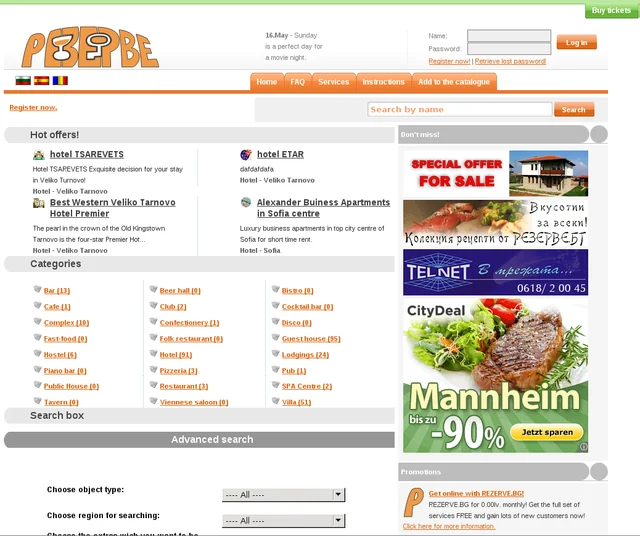
Later, Rezerve.bg tried to bring real-time reservations for hotels, restaurants, and events onto the web in Bulgaria. The wider set of projects included E-Dnevnik, a school record and notification system, and smaller services built with a mix of .NET and web technologies. I was involved in both building and supervising parts of this work while balancing other responsibilities.

The archived Rezerve interface is unmistakably of its era. Under the dense navigation and tiny controls was a serious question I still care about: how do you make a complicated real-world decision easier for someone who does not want to think about the system behind it?

Archived Rezerve.bg booking website with orange navigation, venue listings, and period advertisements.
Rezerve.bg screenshot from the original personal-site archive.
06 / 2004–2010

When images became data

Augmented-reality and computer-vision research moved my attention from screens alone to the geometry of the physical world.

At Fraunhofer IGD, work on augmented and virtual reality included interest-point detection and matching for projects such as MATRIS and iTACITUS. The problem was no longer just presenting an image. It was understanding enough about what the camera saw to place digital information in the physical world.

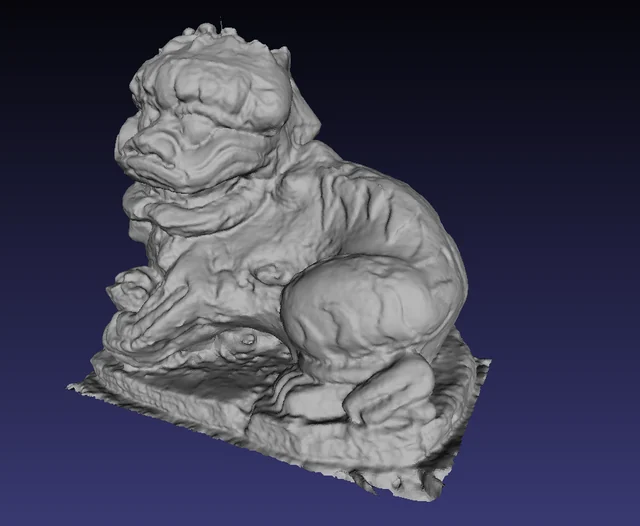
At DFKI, the wider project portfolio included PAMAP, while CAPTURE brought a different scale of difficulty: reconstructing three-dimensional models from large panoramic, high-dynamic-range image sets. Handling the volume of data demanded careful structures and algorithms as much as visual ingenuity. I also enjoyed a smaller sensor-fusion experiment that used motion data to navigate a Google Earth view in a 3D display setup.

That period widened my idea of what software could be. Mathematics, systems work, physical devices, and human perception all met in the same problem. It is a through-line I still recognize whenever a new technology looks impressive but has not yet become useful to someone.

Grayscale three-dimensional reconstruction of a dragon sculpture against a dark indigo background.
Research image preserved in the original personal-site archive.
Keep the conversation going

Curious about one of these?

I love talking about the odd decisions, dead ends, people, and small breakthroughs behind this work. If something here catches your eye, reach out and ask me about it.

Start a conversation ↗